Service engineering begins with observed conditions

Hako service guidance from route brief to daily care

A support plan works when operations, procurement, the operator, and maintenance describe the same machine and the same route. Hako inquiries therefore begin with identification, floor conditions, usage pattern, and the exact symptom or selection question—not a generic request for the “best” scrubber.

For a new application, document floor material, soil, cleanable area, minimum clearance, ramps, drains, fill and dump travel, charging access, shift window, and who performs daily care. For an existing machine, add model and serial identification where appropriate, current hours, when the condition occurs, and which documented checks were completed.

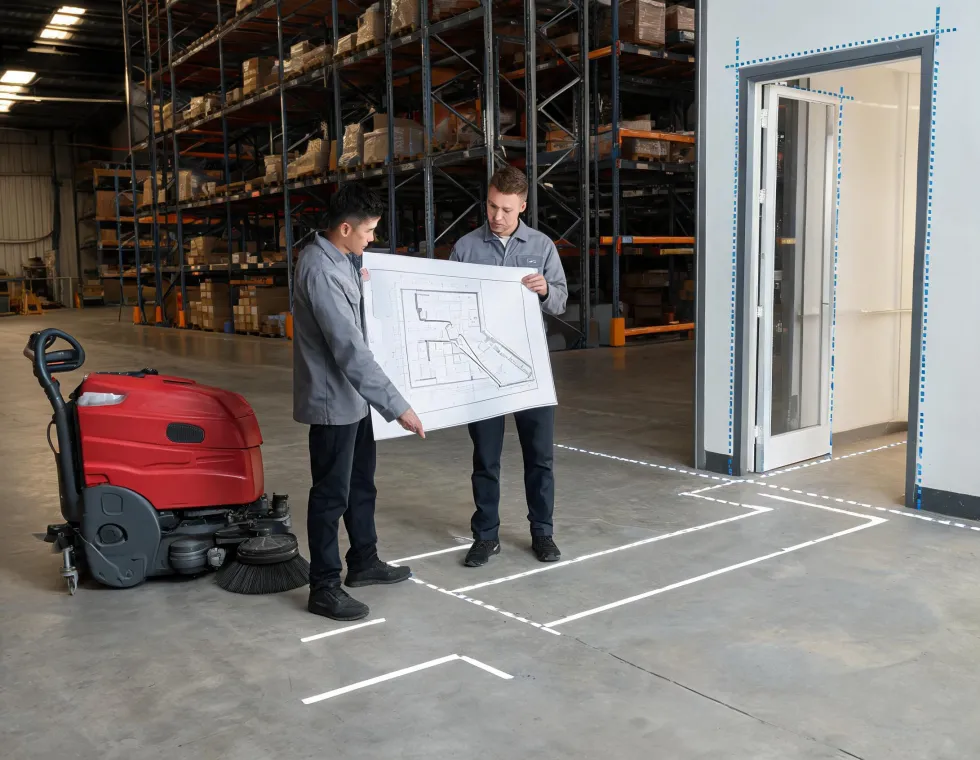
Hako application engineer reviewing a facility route
01

Application and demonstration planning

The route brief is converted into a test boundary: representative floor zone, defined soil condition, fixed brush or pad, approved chemistry, consistent solution setting, chosen travel speed, and a documented start/end state. The trial should include the narrow turn, joint, ramp, or contaminated edge that is most likely to expose a mismatch.

Results are recorded as observations—setup time, cleaning time, refill or dump interruption, pickup pattern, operator intervention, and post-run condition. A short trial on a prepared smooth area does not establish performance across an entire facility.

02

Commissioning and operator handoff

A handoff covers pre-use inspection, filling, consumable selection, startup, normal route behavior, turns, recovery checks, shutdown, tank rinsing, blade and brush inspection, charging or cord care, and storage. The procedure needs assigned ownership and a visible escalation path when pickup, noise, vibration, controls, or charging behavior changes.

Site safety rules and the exact machine instructions govern. Training cannot remove environmental limits such as unsuitable floor finish, unapproved chemistry, excessive slope, insufficient ventilation, or restricted access to water and electrical service.

Questions that improve diagnosis

Describe sequence, not conclusions

“Poor pickup” can point to several different conditions. State whether the symptom appears on straight runs or turns, after a specific elapsed time, on one floor zone, with a particular blade position, or only after debris enters the recovery path.

Provide machine identification, hour reading if available, floor and soil context, sequence of events, indicator state, sounds or vibration, photographs that do not expose confidential information, and the safe checks already completed under the manual.

No. Website content cannot verify the exact machine configuration, stored energy, electrical state, local requirements, or safe isolation. Current instructions and qualified service determine what work is permitted.

Record battery state, charging history, ambient conditions, travel pattern, brush pressure, solution and vacuum settings, accessory load, stop time, and route utilization. A single elapsed-time figure without test conditions is not a comparable result.
Unscoped request

“We need a large scrubber.”

  • Total building area only
  • No minimum clearance
  • No worst-case soil
  • No refill or dump path
  • No maintenance ownership
Decision-ready brief

Route and method are measurable

  • Cleanable area separated from total area
  • Narrowest turn, door, lift, and storage path measured
  • Surface, finish, soil, and approved chemistry recorded
  • Operating window and non-cleaning travel identified
  • Daily and scheduled care assigned

Boundary: theoretical area rate is a planning input, not a field result. Setup, transport, obstruction, refill, dump, overlap, turns, operator pace, and end-of-shift care reduce route utilization. Compare machines under the same written test conditions.

Prepare the evidence

Send Hako a route and service brief

Include the machine family or identification, floor and soil, difficult route section, shift window, water and power access, current method, and desired verification step. Do not send credentials or unrelated personal information.